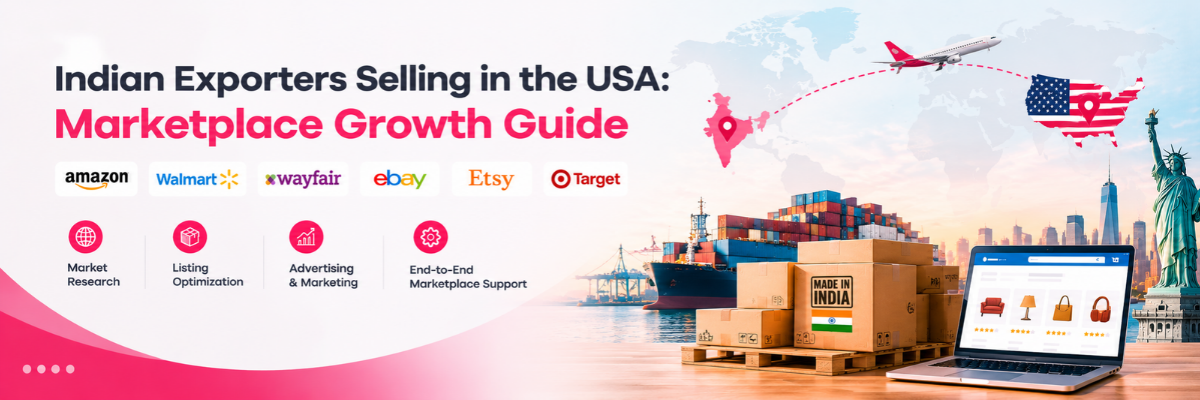
The United States offers significant opportunities for Indian exporters looking to expand beyond traditional wholesale and distribution channels. From home décor and furniture to textiles, fashion accessories, jewelry, beauty products, and consumer goods, Indian businesses can reach American customers through online marketplaces.
However, entering the US ecommerce market requires more than competitive pricing and quality products. Exporters must understand local customer expectations, marketplace requirements, product listing standards, advertising strategies, inventory planning, and fulfillment operations.
This is where a structured marketplace growth strategy becomes essential. By combining product quality with local market knowledge and professional marketplace management, Indian exporters can build a stronger presence in the competitive American ecommerce landscape.
1. Understand the US Ecommerce Market Before Expanding
Before launching products in the United States, Indian exporters should research their target customers and competitors.
American shoppers often compare product features, prices, reviews, delivery estimates, return policies, and brand credibility before purchasing. A product that performs well in the Indian market may require different positioning to attract US customers.
Start by researching:
Customer demand: Identify product categories and features that American shoppers are searching for.
Competitor pricing: Compare similar products, shipping costs, discounts, and product positioning.
Customer expectations: Review common complaints, product questions, ratings, and return reasons.
Profitability: Calculate marketplace fees, advertising costs, fulfillment expenses, shipping, duties, and other applicable costs.
Seasonality: Plan inventory around relevant US shopping events, holidays, and category-specific demand.
Thorough research helps exporters identify realistic opportunities before investing heavily in inventory or advertising.
2. Choose the Right Marketplaces for Your Products
Not every marketplace is suitable for every export business. Indian sellers should select platforms based on their product category, target audience, operational capabilities, and business objectives.
Amazon USA
Amazon is a major channel for reaching US online shoppers across categories such as home goods, apparel, beauty, electronics, and accessories.
Exporters need competitive product listings, high-quality images, relevant keywords, clear product specifications, and a strategy for advertising and inventory management.
Walmart Marketplace
Walmart Marketplace provides another opportunity for eligible international businesses to reach US customers. Sellers should review Walmart’s current international seller eligibility, documentation, catalog requirements, and fulfillment policies before applying.
A strong Walmart strategy includes accurate product data, competitive pricing, inventory availability, and compliance with marketplace standards.
Wayfair
Wayfair is particularly relevant to exporters offering furniture, home furnishings, décor, lighting, and related products.
Businesses targeting this channel should pay close attention to product dimensions, materials, assembly information, packaging, shipping arrangements, and product imagery.
eBay and Etsy
eBay may suit exporters selling collectibles, accessories, electronics, and other products with established demand. Etsy can be relevant to eligible businesses selling handmade goods, original designs, and qualifying craft products.
Each platform has different seller requirements and customer expectations. Research these differences before committing to a marketplace expansion plan.
For businesses entering several channels, marketplace growth and account management guidance from Rey Ecom Ops can help identify the operational areas that need attention.
3. Prepare Your Business for Cross-Border Selling
Selling from India to the United States involves operational and regulatory considerations beyond creating an online store.
Before launching, exporters should evaluate their business structure, marketplace eligibility, tax obligations, product compliance, shipping arrangements, and customer service processes.
Important preparations include:
Business documentation: Keep company registration, ownership details, banking information, and other requested documents ready.
Tax and customs planning: Consult qualified professionals regarding applicable US tax requirements, Indian export procedures, customs classification, duties, and importer responsibilities.
Product compliance: Verify whether the product requires testing, certifications, labeling, warnings, or other approvals.
Shipping and fulfillment: Compare direct shipping from India with eligible US-based fulfillment options.
Returns management: Establish a practical process for customer returns, refunds, damaged shipments, and product replacements.
Requirements vary by marketplace, product category, and business model. Confirm current rules with the relevant authorities and marketplace before launching.
4. Optimize Product Listings for American Shoppers
Product listings influence both marketplace visibility and purchase decisions. Directly translating an Indian product description into English is rarely enough to create a competitive US listing.
Exporters should adapt their content to local search behavior and customer expectations.
Focus on Marketplace SEO
Research relevant search terms and incorporate them naturally into product titles, bullet points, descriptions, and supported keyword fields.
Avoid keyword stuffing or making claims that cannot be substantiated.
Improve Product Images
Use clear, high-resolution images that accurately represent the product. Include relevant detail shots, dimensions, material information, and lifestyle images where permitted by the platform.
For furniture and home décor, dimensions and scale are especially important. For apparel and accessories, product details, sizing, materials, and color accuracy can influence buying decisions.
Highlight Practical Benefits
Explain how the product meets a customer’s needs. Include useful specifications, care instructions, compatibility information, package contents, and other relevant details.
Professional listing optimization and marketplace support can help exporters improve product content and maintain more consistent catalog information across channels.
5. Build a Profitable Marketplace Advertising Strategy
Launching products does not guarantee visibility. Advertising can help new listings reach relevant shoppers, but campaigns need careful planning and ongoing optimization.
Indian exporters should begin with a manageable advertising budget and clear performance goals.
An effective advertising strategy includes:
Researching high-intent and relevant search terms.
Separating branded, non-branded, and product-targeting campaigns where appropriate.
Monitoring impressions, clicks, conversion rates, advertising cost of sales, and total advertising cost of sales.
Identifying irrelevant search terms and reducing wasted spend.
Evaluating advertising performance alongside organic sales and overall profitability.
Do not judge campaign success solely by revenue. Marketplace commissions, product costs, fulfillment, returns, and advertising expenses all affect the final margin.
A structured approach to marketplace advertising helps exporters make informed decisions as they gather performance data and expand their product range.
6. Manage Inventory, Fulfillment, and Customer Experience
Operational problems can undermine marketplace growth even when products receive strong demand.
Exporters must balance inventory availability, delivery expectations, storage costs, and cash flow. Shipping products individually from India may work for some businesses, while other sellers may benefit from eligible US-based fulfillment arrangements.
Before choosing a model, evaluate delivery speed, fulfillment fees, storage requirements, import procedures, return handling, and replenishment timelines.
Inventory planning should account for lead times between production, export, customs clearance, and stock availability in the United States.
Customer experience also matters. Accurate delivery information, prompt responses, reliable order processing, and clear return policies help businesses maintain marketplace performance.
This is why Marketplace Account Management Services can be valuable for businesses that need consistent oversight of listings, advertising, inventory, and day-to-day marketplace operations.
7. Why Indian Exporters Need Local Marketplace Expertise
International expansion creates a learning curve. Exporters must understand the differences between Indian and American shopping behavior, platform-specific requirements, local competition, and operational expectations.
A marketplace specialist can help businesses prioritize the right activities, maintain accurate catalogs, monitor performance, and identify opportunities for improvement.
Professional Ecommerce Account Management Service support can cover areas such as:
Marketplace onboarding and account setup support.
Product catalog management and listing optimization.
Advertising campaign management.
Inventory monitoring and operational coordination.
Account health monitoring and policy-related support.
Sales reporting and performance analysis.
Multi-marketplace expansion planning.
For exporters managing several marketplaces, a dedicated support team can also help establish consistent workflows and reduce the burden of daily account operations.
The objective is not simply to list more products. It is to build a sustainable business with clear processes, reliable execution, and measurable commercial goals.
8. Create a Step-by-Step US Marketplace Expansion Plan
A phased approach can help Indian exporters reduce avoidable risks and make better use of their resources.
Phase 1: Market Research
Identify promising product categories, analyze competitors, estimate costs, and determine which marketplaces align with your products.
Phase 2: Business and Compliance Readiness
Review seller eligibility, documentation, tax considerations, product compliance, shipping arrangements, and return processes.
Phase 3: Marketplace Launch
Prepare product listings, optimize images and content, establish pricing, and organize inventory and fulfillment.
Phase 4: Performance Optimization
Monitor search visibility, conversions, advertising results, customer feedback, and profitability. Improve underperforming listings and campaigns.
Phase 5: Expansion
Once the initial channel demonstrates sustainable performance, evaluate additional marketplaces and complementary products based on demand, resources, and operational readiness.
This approach allows businesses to learn from actual marketplace data rather than expanding based on assumptions.
Conclusion
Selling in the United States can create new growth opportunities for Indian exporters, but long-term success requires more than access to an online marketplace.
Businesses need local market understanding, competitive product listings, disciplined advertising, reliable fulfillment, accurate inventory planning, and ongoing performance monitoring.
Choosing the right marketplaces and establishing efficient operations can help exporters build a stronger foundation for international ecommerce growth.
Rey Ecom Ops supports ecommerce businesses with marketplace account management, listing optimization, advertising, inventory coordination, and operational assistance across platforms including Amazon, Walmart, Wayfair, eBay, and Etsy.
Planning to expand your Indian export business into the US ecommerce market? Connect with Rey Ecom Ops to discuss your marketplace goals and identify the support your business may need.