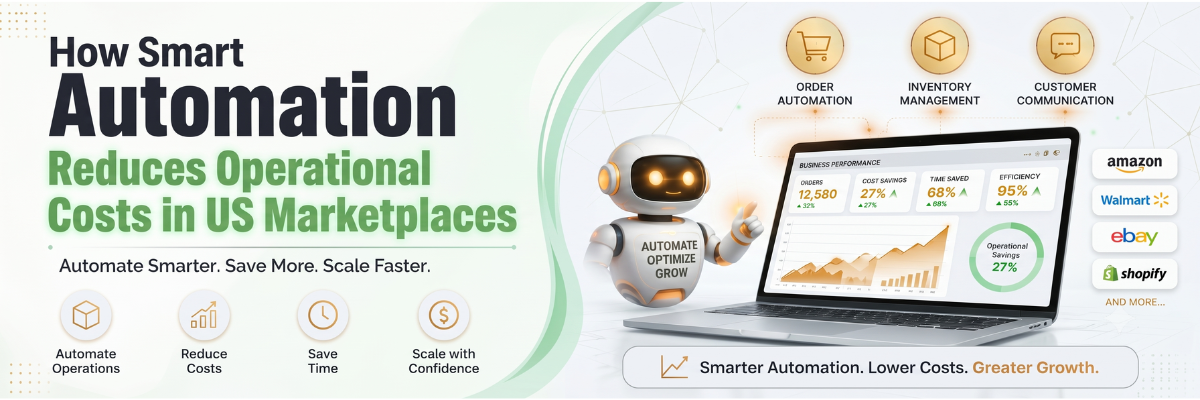
Running a successful ecommerce business in the US marketplace landscape requires more than just selling products. Sellers need to manage inventory, process orders, answer customer questions, optimize listings, monitor performance, and maintain account health — all while controlling operational costs.
As marketplaces like Amazon, Walmart, eBay, and other platforms continue to become more competitive, manual operations can quickly become expensive and time-consuming.
This is where smart automation changes the game.
With AI-powered tools and automated workflows, sellers can streamline repetitive tasks, reduce human errors, improve customer experience, and scale their marketplace operations without constantly increasing team size.
For businesses looking for sustainable growth, adopting Amazon automation USA solutions is becoming an essential strategy rather than an optional upgrade.
Why Operational Costs Are Increasing for Marketplace Sellers
Marketplace growth brings new challenges. While increasing sales is the goal, higher sales volume also creates more operational pressure.
Common cost challenges include:
- Managing thousands of customer messages
- Processing increasing order volumes
- Maintaining accurate inventory levels
- Updating product information across marketplaces
- Monitoring account performance
- Handling returns and refunds
- Managing advertising campaigns
- Preventing stockouts and overstocking
Many sellers try to solve these challenges by hiring additional employees. However, adding more staff increases expenses through:
- Salaries
- Training costs
- Management overhead
- Communication gaps
- Operational complexity
Smart automation helps businesses handle more work without adding unnecessary costs.
What Is Smart Automation in Ecommerce?
Smart automation uses artificial intelligence, software integrations, and automated workflows to complete repetitive marketplace tasks with minimal manual involvement.
Instead of employees spending hours performing routine activities, automated systems can manage:
- Order processing
- Inventory tracking
- Customer communication
- Reporting
- Data analysis
- Listing updates
- Workflow management
The goal is not to replace teams but to help businesses use their resources more efficiently.
A seller who previously needed multiple people for daily operations can often manage the same workload with fewer manual processes.
How AI Automation Reduces Marketplace Operational Costs
1. Automated Order Processing Saves Time and Resources
Order management becomes increasingly complex as sales grow.
Manual order processing requires teams to:
- Review incoming orders
- Verify information
- Update statuses
- Coordinate fulfillment
- Track shipments
Automation simplifies this process by connecting marketplace orders with fulfillment systems.
AI-powered order management can:
- Automatically capture orders
- Update customers with shipping information
- Reduce processing delays
- Minimize human mistakes
- Improve fulfillment accuracy
This allows sellers to handle higher order volumes without increasing operational staff.
2. AI-Powered Inventory Management Prevents Costly Mistakes
Inventory mistakes can directly impact profitability.
Two major problems sellers face are:
Overstocking
Excess inventory creates:
- Higher storage fees
- Reduced cash flow
- Slow-moving stock
Stockouts
Running out of inventory leads to:
- Lost sales
- Lower rankings
- Reduced customer satisfaction
Automated inventory systems analyze sales patterns, demand trends, and stock levels to help sellers make better decisions.
Benefits include:
- Real-time inventory monitoring
- Automated stock alerts
- Better forecasting
- Reduced storage costs
- Improved inventory planning
For growing brands, automation creates better control over inventory without requiring constant manual tracking.
3. Automated Customer Messaging Improves Buyer Experience
Customer communication plays a major role in marketplace success.
Buyers expect quick responses regarding:
- Order updates
- Shipping questions
- Product information
- Returns and refunds
Delayed responses can negatively affect customer satisfaction and account performance.
AI messaging tools help sellers:
- Provide instant responses
- Handle frequently asked questions
- Send automated order updates
- Improve response times
This allows businesses to maintain excellent customer service without requiring a large support team.
4. Automation Reduces Human Errors
Manual operations often lead to costly mistakes.
Examples include:
- Incorrect inventory updates
- Wrong order details
- Delayed customer responses
- Listing errors
- Missed marketplace notifications
Automation creates standardized processes that reduce errors and improve consistency.
Fewer mistakes mean:
- Lower operational expenses
- Better customer reviews
- Improved marketplace performance
- Less time spent fixing problems
5. AI Analytics Helps Make Better Business Decisions
Successful marketplace selling requires continuous analysis.
AI-powered analytics can help sellers understand:
- Sales trends
- Customer behavior
- Inventory movement
- Product performance
- Advertising efficiency
Instead of spending hours collecting reports, sellers can quickly identify:
- Which products are growing
- Which products need improvement
- Where costs are increasing
- Where opportunities exist
Better decisions lead to improved profitability.
Scaling Without Increasing Team Size
One of the biggest advantages of automation is scalability.
A seller managing 100 orders per day and a seller managing 5,000 orders per day do not need completely different processes.
With automation, businesses can:
- Expand product catalogs
- Enter new marketplaces
- Increase order volume
- Improve customer support
- Manage multiple channels
without increasing operational complexity at the same speed.
This is especially valuable for brands expanding across Amazon, Walmart, eBay, and other US marketplaces.
The Role of Ecommerce Account Management in Georgia for Growing Sellers
Many US sellers partner with experienced ecommerce professionals to manage marketplace operations efficiently.
Professional ecommerce account management in Georgia services help brands by combining automation technology with marketplace expertise.
These services can support:
- Marketplace account monitoring
- Listing optimization
- Inventory management
- Order operations
- Customer support management
- Advertising optimization
- Performance reporting
Instead of building a large internal team, businesses can access specialized support while keeping operational costs controlled.
Automation + Human Expertise Creates Better Results
Automation works best when combined with marketplace knowledge.
AI tools can process information quickly, but experienced ecommerce professionals provide:
- Strategy
- Problem-solving
- Marketplace compliance knowledge
- Growth planning
- Optimization decisions
The strongest ecommerce businesses use automation to handle repetitive work while teams focus on growth opportunities.
Future of Ecommerce Operations: Automation-First Growth
The future of marketplace selling will belong to businesses that can operate faster and more efficiently.
As competition increases, sellers who depend completely on manual processes may struggle with rising costs.
Automation helps brands:
✅ Reduce operational expenses
✅ Improve workflow efficiency
✅ Handle larger sales volumes
✅ Deliver faster customer support
✅ Make smarter decisions
✅ Scale without unnecessary hiring
For US marketplace sellers, adopting automation is no longer just about saving time — it is about building a more profitable and scalable business model.
Final Thoughts
Smart automation gives ecommerce businesses the ability to grow while keeping operational costs under control.
From AI-powered order processing and inventory management to automated customer communication, technology allows sellers to work smarter instead of simply working more.
Businesses investing in Amazon automation USA strategies and professional ecommerce account management in Georgia support can create efficient operations designed for long-term marketplace success.
The future of ecommerce growth is not only about selling more products — it is about building systems that can support growth efficiently.