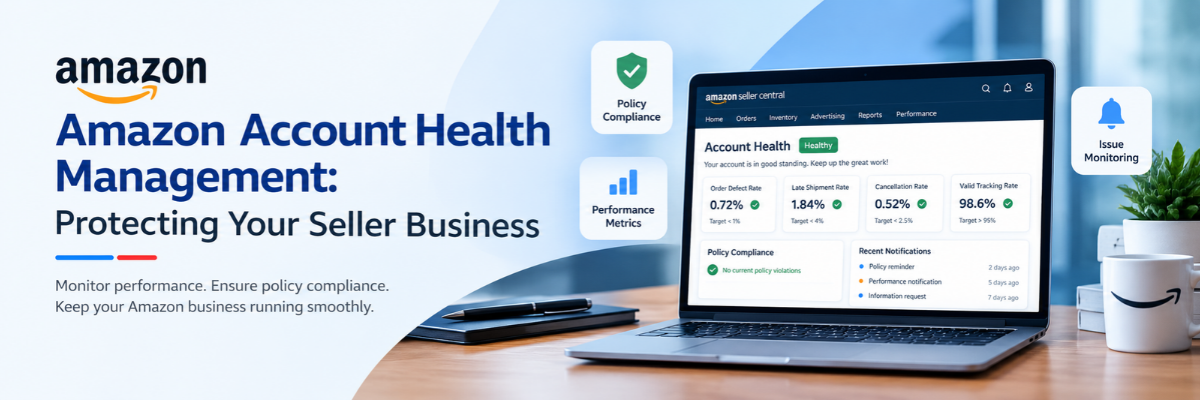
Selling on Amazon offers businesses across the United States an opportunity to reach millions of customers. However, maintaining a successful seller account requires more than product listings, inventory management, and advertising campaigns. Sellers must also follow Amazon’s policies, maintain strong performance metrics, and respond quickly to account-related issues.
Amazon account health management helps sellers monitor these requirements, identify potential risks, and maintain stable marketplace operations. A missed policy notification, an increase in order defects, or a pattern of late shipments can affect account performance and create challenges for business growth.
For sellers managing multiple products or a growing catalogue, regular monitoring becomes even more important. A structured approach to account health helps businesses identify problems early, resolve issues systematically, and protect their ability to sell on Amazon.
What Is Amazon Account Health Management?
Amazon account health management is the ongoing process of monitoring seller performance, reviewing policy compliance, addressing customer-related issues, and responding to account notifications.
Amazon provides account health information through Seller Central, where sellers can review relevant policy compliance requirements, customer service performance, shipping performance, and other account-related indicators.
Effective account health management involves more than checking the dashboard occasionally. Sellers need to understand what each metric means, investigate changes, and take corrective action when performance falls outside the required standards.
For US-based Amazon sellers, this process is particularly important when managing large product catalogues, high order volumes, multiple fulfilment methods, or seasonal sales fluctuations.
A proactive approach helps sellers maintain better operational control while reducing the risk of avoidable account problems.
Why Amazon Account Health Matters for Your Business
Account health can influence a seller’s ability to operate consistently on Amazon. Policy violations, poor customer service performance, and unresolved account issues may result in listing restrictions, selling limitations, or other enforcement actions, depending on the circumstances.
Here are the main reasons sellers should prioritise account health management.
1. Protecting Selling Privileges
Amazon requires sellers to comply with its selling policies and applicable performance standards. Serious or repeated violations can lead to restrictions or account deactivation.
Regular monitoring helps sellers identify policy notifications, investigate suspected violations, and prepare appropriate responses before issues become more difficult to resolve.
2. Maintaining Customer Trust
Customer complaints, order defects, and fulfilment problems can indicate operational weaknesses. Monitoring these signals allows sellers to identify recurring issues and improve the customer experience.
For example, repeated complaints about damaged products may point to packaging problems, while negative feedback about delivery delays may indicate fulfilment or carrier issues.
3. Reducing Operational Disruptions
Account restrictions can interrupt sales, affect inventory planning, and create additional work for support teams. Maintaining clear compliance processes helps sellers reduce preventable disruptions and respond more efficiently when problems occur.
4. Supporting Sustainable Growth
As an Amazon business expands, managing account health becomes more complex. New products, additional suppliers, higher order volumes, and new fulfilment arrangements can introduce new compliance risks.
A consistent monitoring process helps sellers identify operational weaknesses while continuing to expand their catalogue and sales activity.
Key Amazon Account Health Metrics Sellers Should Monitor
Amazon sellers should regularly review the metrics and policy indicators relevant to their account and fulfilment model. The exact requirements and applicable timeframes can vary by metric and programme, so sellers should verify current standards in Seller Central.
Order Defect Rate (ODR)
Order Defect Rate measures the percentage of orders with qualifying defects, including negative feedback, A-to-z Guarantee claims, and credit card chargebacks.
Amazon’s general performance target is an ODR below 1%.
To manage this metric effectively, sellers should:
Review negative customer feedback and recurring complaints.
Investigate product quality and packaging issues.
Monitor claims and respond within applicable deadlines.
Identify products associated with repeated customer dissatisfaction.
Improve processes that contribute to order defects.
Addressing the underlying cause is more effective than treating each complaint as an isolated incident.
Late Shipment Rate
Late Shipment Rate measures the percentage of seller-fulfilled orders shipped after the expected ship date.
Amazon’s general target is a Late Shipment Rate below 4%.
Sellers can reduce late shipments by improving inventory accuracy, setting realistic handling times, monitoring order queues, and ensuring shipping confirmations are submitted correctly and on time.
Businesses experiencing repeated delays should also review warehouse workflows, supplier lead times, and carrier collection schedules.
Pre-Fulfilment Cancellation Rate
Pre-fulfilment Cancellation Rate tracks seller-initiated cancellations before an order is fulfilled.
Amazon’s general target is a rate below 2.5%.
Stock discrepancies, inaccurate inventory feeds, and supplier shortages are common operational factors that can contribute to cancellations.
Sellers should maintain accurate stock levels, synchronise inventory across relevant channels, and review replenishment processes to reduce avoidable cancellations.
Valid Tracking Rate
Valid Tracking Rate measures whether seller-fulfilled shipments have valid tracking information provided to Amazon.
Requirements can vary by category and fulfilment circumstances. Sellers should review the applicable thresholds and reporting periods shown in Seller Central.
To improve tracking compliance, businesses should use supported shipping services, confirm that tracking numbers are accurate, and ensure shipment confirmations are submitted promptly.
Policy Compliance and Account Health Rating
The Account Health Rating (AHR) provides eligible sellers with an overview of their account’s compliance status and certain policy-related risks. It should be reviewed alongside the individual policy notices and performance metrics displayed in Seller Central.
Sellers should pay particular attention to:
Product authenticity and intellectual property complaints.
Restricted product and category requirements.
Product safety and regulatory compliance.
Listing content and product detail policy violations.
Suspected policy abuse or other compliance concerns.
Requests for invoices, documentation, or additional information.
A strong account health position requires ongoing compliance, not just a favourable dashboard score.
Common Amazon Account Health Problems and How to Prevent Them
Many account health issues develop gradually because sellers overlook early warning signs or lack a consistent review process.
Intellectual Property Complaints
Intellectual property complaints may involve trademarks, copyrights, patents, or other protected rights. Sellers should ensure that their products and listing content are authorised and that supporting documentation is available where required.
Prevention: Review supplier relationships, maintain genuine purchase records, check product and brand authorisation requirements, and investigate complaints promptly.
Product Authenticity Concerns
Amazon may request documentation to verify product authenticity or supply-chain legitimacy. Missing, inconsistent, or inadequate records can make it more difficult to resolve these concerns.
Prevention: Retain valid supplier invoices, purchase records, brand authorisations where applicable, and relevant product documentation. Ensure documents are accurate and correspond to the products being sold.
Restricted Product Violations
Some products require specific approvals, documentation, labelling, or compliance with applicable regulations. Other products may be prohibited from sale altogether.
Prevention: Check category and product restrictions before listing new items. Review applicable US requirements and Amazon policies before expanding into regulated or sensitive product categories.
Poor Customer Service Performance
Delayed responses, unresolved complaints, and repeated fulfilment issues can contribute to customer dissatisfaction and account performance problems.
Prevention: Monitor customer messages, establish clear response procedures, investigate recurring complaints, and create a process for escalating complex cases.
Listing Policy Violations
Product titles, bullet points, descriptions, images, and claims must comply with Amazon’s listing requirements. Unsupported product claims or prohibited content can lead to listing suppression or other enforcement actions.
Prevention: Audit product detail pages regularly, verify claims against reliable product documentation, and update content when Amazon’s policies or requirements change.
How to Build an Effective Amazon Account Health Monitoring Process
A structured monitoring process helps sellers move from reactive problem-solving to proactive account management.
Step 1: Review the Account Health Dashboard
Check the Account Health page in Seller Central regularly. Review policy violations, performance indicators, unresolved notifications, and any requests for additional information.
The review frequency should reflect the size, risk profile, and order volume of the business. High-volume or higher-risk accounts may need more frequent checks.
Step 2: Prioritise Issues by Risk and Urgency
Not every notification requires the same response. Prioritise urgent account restrictions, serious policy violations, and requests with approaching deadlines.
Create an issue tracker containing the notification date, affected ASIN or product, issue type, responsible team member, required action, submission deadline, and current status.
This helps prevent important cases from being overlooked.
Step 3: Investigate the Root Cause
Before submitting an appeal or corrective response, determine why the issue occurred.
For example, an authenticity complaint may require a review of supplier documentation, while repeated late shipments may indicate inadequate inventory planning or unrealistic handling times.
A strong corrective process should explain what happened, identify the underlying cause, and document the steps taken to prevent recurrence.
Step 4: Prepare Accurate Supporting Documentation
Depending on the issue, Amazon may request invoices, authorisation letters, compliance certificates, product images, shipping records, or other evidence.
Ensure that submitted documents are genuine, complete, legible, and relevant to the specific request. Never alter documents or make unsupported claims.
Step 5: Submit Clear and Relevant Responses
When an appeal or response is required, address the actual concern raised by Amazon.
A useful response typically includes:
A clear explanation of the issue.
Evidence supporting the explanation.
Corrective actions already completed.
Preventive measures designed to reduce recurrence.
Relevant supporting documents.
Avoid generic responses that do not address the specific violation. Follow the instructions and deadlines provided in Seller Central.
Step 6: Track Resolution and Review Recurring Issues
Keep records of submissions, Amazon responses, and any additional requirements. Once an issue is resolved, review whether the corrective measures are working.
If similar violations recur, reassess the underlying process rather than repeatedly submitting similar appeals.
The Role of Amazon Account Health Specialists
Managing account health can require considerable time, particularly for businesses with large catalogues, multiple brands, and complex supplier or fulfilment arrangements.
Amazon account health specialists can support sellers by reviewing compliance notifications, monitoring performance indicators, investigating potential risks, and coordinating corrective actions.
Their responsibilities may include:
Conducting regular account health reviews.
Identifying potential policy compliance risks.
Reviewing listing restrictions and suppression issues.
Organising supporting documents for account-related cases.
Assisting with appeal preparation and corrective action plans.
Monitoring case progress and follow-up requirements.
Coordinating with inventory, customer service, and fulfilment teams.
Maintaining records of recurring issues and preventive actions.
Specialists should work with accurate business records and current Amazon policies. They cannot guarantee account reinstatement, prevent every enforcement action, or override Amazon’s decisions.
For sellers without a dedicated internal compliance team, external account management support can help establish clearer processes and improve day-to-day oversight.
How Amazon Account Management Services Help Protect Your Business
Professional Amazon account management services can help sellers coordinate the operational activities that contribute to account stability.
Rather than treating account health as a separate task, an effective management approach connects compliance monitoring with listing management, inventory accuracy, order processing, customer service, and performance reporting.
For example, an inventory discrepancy may contribute to cancellations, while incorrect listing information may generate customer complaints or policy concerns. Addressing these operational issues can help reduce preventable risks.
Businesses evaluating external support should look for services that include relevant account health reviews, notification tracking, policy compliance assistance, documentation management, and clear reporting.
Dedicated Amazon account health monitoring services can also help sellers establish a repeatable review schedule, track open issues, and identify changes that require attention.
When complex cases arise, experienced Amazon account health specialists can help organise investigations, prepare evidence-based responses, and coordinate follow-up actions.
The right support model depends on the seller’s account size, product category, internal resources, and operational complexity. Sellers should confirm the scope of services before engaging a provider, especially when appeal support, compliance documentation, or urgent case handling is required.
Best Practices for Maintaining Amazon Account Health in the USA
US Amazon sellers can strengthen their account management processes by following several practical measures.
Maintain Accurate Supplier and Product Records
Keep purchase invoices, supplier details, product specifications, authorisations, and relevant compliance documentation organised and accessible.
Audit Listings Regularly
Review product content, images, claims, variations, and category requirements. Correct inaccurate information before it develops into a more serious issue.
Monitor Inventory and Fulfilment
Use reliable inventory records, maintain realistic handling times, and review order processing and tracking workflows. Better operational accuracy can help reduce cancellations and shipping-related performance problems.
Respond to Amazon Notifications Promptly
Check Seller Central and relevant notification channels frequently. Assign responsibility for reviewing and resolving account-related cases.
Keep Up With Policy Changes
Amazon’s policies, documentation requirements, and programme standards can change. Review official policy updates and verify current requirements before making important account decisions.
Document Corrective Actions
Record the cause of each significant issue, the steps taken to resolve it, and the controls introduced to prevent recurrence. This creates a practical reference for future investigations.
Review Account Health Before Major Expansion
Before launching new products, entering sensitive categories, or significantly increasing sales volume, review applicable policies, product documentation, inventory processes, and fulfilment readiness.
How Often Should You Monitor Amazon Account Health?
There is no single review frequency that suits every seller. Monitoring should reflect the account’s size, product risk, order volume, and operational complexity.
A practical starting schedule is:
Daily: Review urgent notifications, account restrictions, approaching deadlines, and significant operational problems.
Weekly: Review performance trends, policy compliance issues, customer complaints, and unresolved cases.
Monthly: Conduct a broader account health review, evaluate recurring issues, and assess whether corrective measures are effective.
Before launching new products: Check product eligibility, category restrictions, documentation, listing policies, and applicable compliance requirements.
This schedule is a recommended operational framework, not an official Amazon-mandated timetable. Sellers should increase monitoring frequency whenever their account or product category requires closer oversight.
Conclusion
Amazon account health management is an essential part of running a sustainable marketplace business. By monitoring performance metrics, reviewing policy notifications, maintaining accurate documentation, and resolving problems at their source, sellers can improve operational control and reduce avoidable account risks.
The most effective approach combines regular monitoring with clear accountability and corrective action. Instead of waiting for a restriction or performance problem to interrupt sales, sellers should build account health reviews into their everyday operations.
For businesses that need additional support, Rey Ecom Ops provides Amazon account management services to help coordinate marketplace operations, monitor relevant account issues, and support more consistent account management.
A proactive approach to account health helps Amazon sellers in the USA protect their operations, respond to challenges more effectively, and build a stronger foundation for long-term marketplace growth.