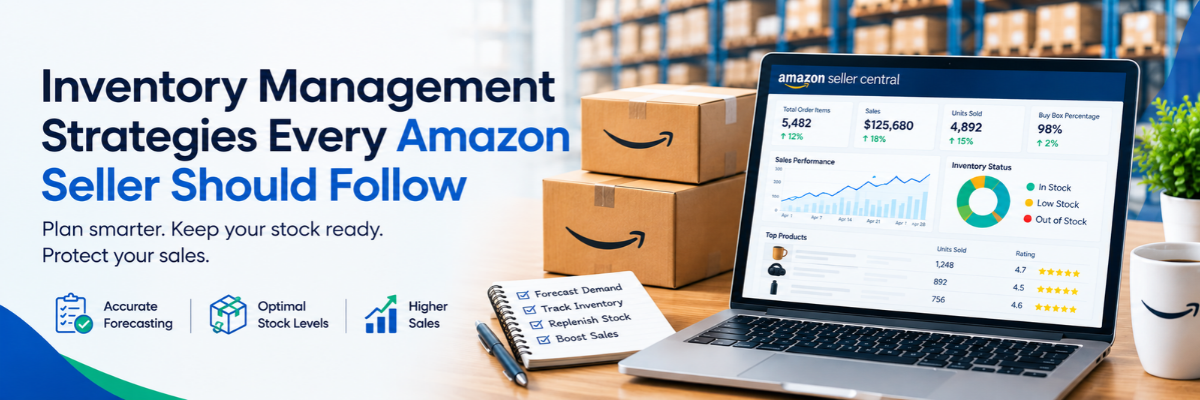
Inventory management is one of the most important parts of running a successful Amazon business. Sellers need to maintain enough stock to fulfil customer orders without investing too much money in products that move slowly. Poor inventory planning can lead to stock shortages, excess inventory, higher storage costs, and missed sales opportunities.
For Amazon sellers operating in the United States, these challenges become more complicated as product demand changes with seasons, promotions, advertising campaigns, and customer buying behaviour. A product that sells consistently today may experience a sudden increase in demand during a major shopping event. Without accurate forecasting and regular inventory monitoring, even an established seller can run out of stock at the wrong time.
A structured inventory management process helps sellers maintain product availability, control operating costs, and make better purchasing decisions. By combining sales data, demand forecasting, supplier coordination, and inventory performance analysis, businesses can build a more reliable Amazon operation.
In this guide, we explore the inventory management strategies every Amazon seller should follow to protect sales opportunities and support long-term business growth.
Why Is Inventory Management Important for Amazon Sellers?
Inventory management involves planning, tracking, replenishing, and controlling the products available for sale. On Amazon, it also requires understanding fulfilment requirements, supplier lead times, storage costs, and the relationship between product availability and sales performance.
Effective inventory management helps sellers:
Reduce stockouts and lost sales opportunities.
Avoid excessive inventory and unnecessary storage expenses.
Maintain better control over purchasing and cash flow.
Improve replenishment planning and supplier coordination.
Prepare for seasonal demand and promotional campaigns.
Identify slow-moving products before they become costly.
Maintain a more consistent customer buying experience.
Inventory management is not simply about keeping more products in stock. It is about keeping the right products in the right quantities at the right time.
1. Use Historical Sales Data to Forecast Demand
Accurate forecasting is the foundation of effective inventory planning. Instead of ordering stock based on assumptions, sellers should analyse historical sales data and identify patterns that can help predict future demand.
Start by reviewing sales performance over the previous 30, 60, and 90 days. For products with seasonal demand, examine data from the same period in previous years where available.
Consider the following factors when forecasting demand:
Average daily and monthly sales.
Sales growth or decline over time.
Seasonal buying patterns.
Advertising campaigns and planned promotions.
Changes in pricing and competitor activity.
Product launches and expected demand increases.
For example, a US seller offering home décor products may experience higher demand during the holiday season. If purchasing decisions are based only on sales from a quieter month, the seller may not order enough inventory to meet upcoming demand.
Forecasting should also account for unusual sales spikes. A short-term increase caused by a promotion may not represent sustainable demand for the following months.
Review forecasts regularly and adjust them when actual sales differ from expectations.
2. Calculate Reorder Points Before Inventory Runs Out
Waiting until a product is almost out of stock before placing a purchase order can put sales at risk. Sellers should establish reorder points for their important products.
A reorder point indicates when additional inventory should be ordered to cover expected demand during supplier lead time, with an additional buffer when appropriate.
A basic formula is:
Reorder Point = Average Daily Sales × Supplier Lead Time + Safety Stock
For example, suppose a product sells 20 units per day, supplier lead time is 15 days, and the seller maintains 100 units as safety stock.
Reorder point = (20 × 15) + 100 = 400 units.
When the inventory position approaches 400 units, the seller should evaluate whether replenishment needs to begin.
This calculation should account for inventory already on order, reserved units, and stock that is unavailable for sale. Reorder points should also be adjusted when sales velocity or supplier lead times change.
3. Maintain Safety Stock for Unexpected Demand
Safety stock provides an additional inventory buffer against unexpected demand increases and supply chain delays.
Without a suitable buffer, even a small disruption can cause a product to become unavailable before the next shipment arrives.
However, holding too much safety stock ties up working capital and may increase storage costs. The right level depends on product demand variability, supplier reliability, lead time, and the cost of a stockout.
Consider maintaining higher safety stock for products that:
Generate a large share of total revenue.
Have unpredictable sales patterns.
Require long manufacturing or shipping lead times.
Are difficult to replenish quickly.
Experience strong seasonal demand.
Review safety stock levels periodically instead of using the same quantity for every product. Products with stable demand and reliable suppliers may need less protection than products with uncertain replenishment timelines.
4. Monitor Amazon Inventory Performance Regularly
Amazon sellers should establish a routine for reviewing inventory levels and identifying potential problems before they affect sales.
Use Amazon Seller Central reports and available inventory planning tools to monitor:
Available inventory.
Reserved inventory.
Inbound shipments.
Estimated days of supply.
Sell-through performance.
Excess and aged inventory.
Restock recommendations.
Product-level sales velocity.
Amazon’s available inventory metrics, fees, and restocking recommendations can change over time and may vary by fulfilment programme. Sellers should check their current Seller Central account for the metrics and policies applicable to their business.
A regular inventory review helps identify products that are selling faster than expected, products that require immediate replenishment, and products that may be accumulating unnecessary stock.
For growing businesses, professional Amazon account management services can help coordinate inventory monitoring with sales performance, account operations, and replenishment planning.
5. Identify and Manage Slow-Moving Inventory
Not every product will sell at the same rate. Some SKUs may generate consistent orders, while others remain in storage for extended periods.
Slow-moving inventory can tie up capital that could otherwise support replenishment of high-demand products. It may also create additional storage expenses and increase the risk of holding unsold stock.
To manage slow-moving inventory:
Review product-level sales and inventory age.
Identify SKUs with declining demand or low sell-through.
Check whether pricing, listing quality, competition, or advertising performance is affecting sales.
Evaluate whether a promotion or price adjustment makes commercial sense.
Reduce future purchase quantities for products with persistent low demand.
Consider eligible removal, liquidation, or other stock disposition options where appropriate.
Avoid automatically increasing advertising spend to clear every slow-moving product. Before investing more in promotion, determine whether the product has sufficient demand, competitive pricing, and a reasonable profit margin.
A balanced inventory strategy protects cash flow while keeping the products customers actually want available.
6. Plan Inventory Around Seasonal Demand
Seasonality has a significant impact on many Amazon categories in the United States. Demand can change around major shopping periods, holidays, back-to-school shopping, and category-specific buying cycles.
Sellers should build a seasonal inventory calendar that includes:
Expected demand increases.
Supplier production and shipping deadlines.
Purchase order dates.
Inbound shipping schedules.
Promotional periods.
Advertising budget changes.
Post-season inventory reduction plans.
For example, a seller planning to increase advertising during a major shopping event should ensure that inventory can support the anticipated sales volume. Driving additional traffic to a product without sufficient stock may waste advertising spend and limit the campaign’s potential.
Planning should begin early enough to account for manufacturing, international shipping, customs where applicable, Amazon receiving times, and other possible delays.
Use previous seasonal sales data as a starting point, then adjust forecasts for current demand, pricing, competition, and marketing plans.
7. Improve Supplier Coordination and Lead-Time Planning
Inventory planning depends on the reliability of the supply chain. Even an accurate forecast can fail if suppliers deliver late or production takes longer than expected.
Amazon sellers should maintain clear communication with manufacturers, wholesalers, and logistics partners.
Important practices include:
Confirming production timelines before placing orders.
Tracking purchase orders from confirmation to delivery.
Reviewing actual lead times against planned lead times.
Maintaining alternative suppliers where commercially practical.
Scheduling replenishment based on realistic delivery estimates.
Keeping documentation and shipment details organised.
Sellers importing products into the United States should also consider international transit times, customs processing, port congestion, and domestic transportation.
Track supplier performance over time. If a supplier repeatedly misses delivery commitments, update the inventory forecast and consider increasing the replenishment buffer or reviewing alternative sourcing options.
Reliable supplier coordination reduces uncertainty and helps sellers maintain more consistent product availability.
8. Optimise Inventory for Amazon FBA
Fulfilment by Amazon (FBA) allows Amazon to handle eligible storage, picking, packing, shipping, and customer service activities under its programme terms. However, sellers remain responsible for planning their inventory and understanding the costs associated with storing products in Amazon’s network.
Effective FBA inventory management requires balancing availability with storage efficiency.
Sellers should:
Replenish products according to demand and inbound lead times.
Review excess and aged inventory reports.
Monitor applicable storage and aged-inventory-related fees.
Check inbound shipment status and receiving delays.
Avoid sending unnecessarily large quantities of slow-selling products.
Maintain sufficient stock for products with reliable demand.
Review current FBA capacity and restocking requirements.
Amazon’s inventory policies and fee structures can change, so sellers should verify current requirements in Seller Central before making replenishment decisions.
The goal is to maintain enough inventory to support sales without allowing excess stock to consume cash or increase avoidable costs.
Professional Amazon inventory management Services can support inventory tracking, replenishment coordination, performance reviews, and stock planning as part of a broader Amazon account management process.
9. Use ABC Analysis to Prioritise Important Products
When a business sells dozens or hundreds of SKUs, it may not be practical to give every product the same level of attention.
ABC analysis helps sellers classify products according to their business importance. A common approach is to use revenue contribution, gross profit, sales velocity, or another relevant measure.
A practical example:
| Category | Typical characteristics | Management approach |
|---|---|---|
| A products | High business impact or strong revenue contribution | Review frequently and prioritise replenishment |
| B products | Moderate business impact | Review regularly and adjust forecasts as needed |
| C products | Lower business impact or slower sales | Control purchasing and monitor excess stock |
These categories should reflect actual business data rather than fixed assumptions. A low-revenue product may still be strategically important if it attracts customers or complements a profitable product range.
ABC analysis helps sellers direct their time and working capital towards the products that matter most to business performance.
10. Coordinate Inventory Planning With Advertising
Inventory and advertising should not operate as separate functions. Advertising can increase sales velocity, which changes how quickly a seller needs to replenish stock.
Before launching or expanding a campaign, review:
Current sellable inventory.
Expected daily sales after the campaign begins.
Supplier lead time and inbound shipment status.
Replenishment costs.
Product profit margins.
The risk of running out of stock during the campaign.
For instance, a product that normally sells 15 units per day may sell 25 units per day after a successful advertising campaign. If replenishment planning continues to use the original sales rate, the product could run out of stock earlier than expected.
Use updated sales data to revise inventory forecasts whenever advertising, pricing, or promotions materially affect demand.
This approach helps sellers align marketing investment with operational capacity and protect sales opportunities.
11. Track Inventory KPIs and Review Performance
Inventory key performance indicators (KPIs) help sellers evaluate whether their current strategy is working.
Important metrics include:
| KPI | What it measures | Why it matters |
|---|---|---|
| Inventory turnover | How frequently inventory is sold and replenished over a period | Helps assess inventory efficiency |
| Sell-through rate | How much inventory is sold relative to the quantity available or received, depending on the chosen definition | Identifies products selling efficiently |
| Days of supply | How long current inventory may last at the estimated sales rate | Helps identify replenishment risks |
| Stockout rate | How frequently products become unavailable | Highlights potential lost-sales problems |
| Forecast accuracy | How closely forecasted demand matches actual demand | Helps improve future purchasing decisions |
| Aged inventory | Inventory held for extended periods | Helps identify potential excess-stock costs |
Use consistent definitions and time periods when comparing performance. For example, inventory turnover calculated using cost of goods sold and average inventory is different from a simple unit-based turnover calculation.
Review KPIs weekly for critical products and monthly for broader business analysis. Investigate the reasons behind changes rather than relying on a single metric to make purchasing decisions.
12. Build a Consistent Inventory Management Process
Successful inventory management requires more than occasional stock checks. Sellers need a repeatable process that assigns responsibility, establishes review schedules, and connects purchasing decisions to current business data.
A practical process can include:
Daily
Monitor urgent stockout risks.
Review unexpected sales changes.
Check critical inbound shipment updates.
Weekly
Update demand forecasts for priority products.
Review reorder points and days of supply.
Identify slow-moving and excess inventory.
Coordinate upcoming purchase orders.
Monthly
Analyse inventory KPIs.
Review supplier reliability and actual lead times.
Evaluate seasonal forecasts.
Adjust safety stock and replenishment rules.
Review inventory costs and working capital requirements.
As the business expands, sellers may need additional reporting, documented standard operating procedures, and dedicated operational support to maintain accuracy across multiple product lines.
Experienced Amazon marketplace account management services can help integrate inventory oversight with listing management, account operations, sales reporting, and other marketplace activities.
Common Inventory Management Mistakes Amazon Sellers Should Avoid
Even experienced sellers can make inventory decisions that reduce profitability or interrupt sales.
Ordering based only on past sales: Historical performance is useful, but forecasts must also consider future promotions, seasonality, competition, and supply chain changes.
Ignoring supplier lead times: Replenishment decisions based on optimistic delivery estimates can leave products unavailable while new stock is still in transit.
Holding too much inventory: Excess stock ties up working capital and may increase storage expenses, particularly when demand slows.
Treating all SKUs equally: High-impact products may need more frequent reviews and stronger replenishment controls than products with limited demand.
Ignoring inbound shipment delays: A purchase order or shipment that has not yet become sellable inventory should not be treated as immediately available stock.
Separating advertising from inventory planning: Successful campaigns can increase sales velocity and create replenishment risks when stock forecasts are not updated.
Avoiding these mistakes helps sellers make better use of their inventory budgets while maintaining product availability.
How Professional Amazon Account Management Supports Inventory Optimisation
As an Amazon business grows, inventory decisions become increasingly connected to advertising, listing performance, fulfilment, supplier coordination, and financial planning.
Managing these activities independently can create gaps in communication and reporting. An inventory forecast may not reflect a planned promotion, or a purchasing decision may not account for a change in product demand.
Professional account management support can help sellers establish a more structured operating process.
Depending on the agreed scope of service, support may include:
Monitoring inventory levels and sales velocity.
Reviewing replenishment requirements.
Coordinating purchase order and inbound shipment tracking.
Identifying slow-moving and excess inventory.
Analysing inventory performance reports.
Coordinating inventory plans with advertising activities.
Maintaining regular operational reports and follow-up schedules.
For US brands, manufacturers, wholesalers, and retailers selling on Amazon, a consistent inventory management process can improve visibility into stock requirements and help reduce avoidable operational problems.
Rey Ecom Ops provides ecommerce marketplace support for businesses seeking to improve their marketplace operations. Explore our Amazon account management services to learn more about the operational support available for your business.
Conclusion
Inventory management plays a direct role in an Amazon seller’s ability to fulfil orders, control costs, and capture sales opportunities. Without accurate forecasting and regular monitoring, businesses can experience stock shortages, excess inventory, and unnecessary pressure on working capital.
The most effective approach combines historical sales analysis, demand forecasting, reorder points, safety stock, supplier coordination, FBA inventory monitoring, and regular KPI reviews.
Sellers should also connect inventory decisions with seasonal demand and advertising plans. When demand changes, replenishment plans must change with it.
By building a consistent, data-driven inventory management process, Amazon sellers in the USA can make more informed purchasing decisions, improve stock availability, and establish a stronger foundation for sustainable growth.
Need support managing your Amazon operations? Visit Rey Ecom Ops to explore our Amazon account management services and discuss your marketplace requirements.