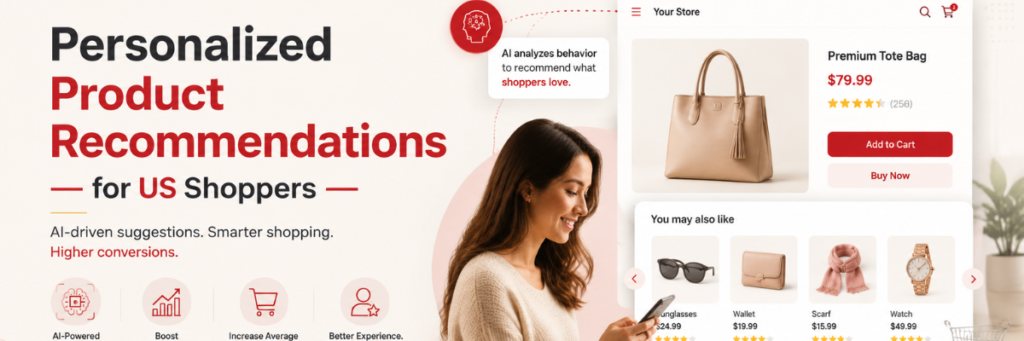
In today’s highly competitive US eCommerce landscape, personalization is no longer a “nice to have” — it is a conversion-driving necessity. Shoppers expect online stores to understand their preferences, predict their needs, and present relevant products instantly.
This is where AI-driven personalization is transforming the way brands sell online. From Amazon to Shopify, businesses leveraging smart recommendation systems are seeing higher engagement, stronger conversions, and improved customer loyalty.
The concept behind Amazon personalization USA strategies has now become a benchmark for the entire eCommerce ecosystem — and brands offering ecommerce conversion services are rapidly adopting similar models across marketplaces.
Why Personalized Recommendations Matter in US eCommerce
US shoppers are highly selective and experience-driven. They don’t just buy products — they buy relevance, convenience, and confidence.
Personalized product recommendations help in:
- Reducing decision fatigue
- Increasing average order value (AOV)
- Improving product discovery
- Enhancing shopping experience
- Boosting repeat purchases
When a shopper lands on a product page and immediately sees “You may also like” or “Frequently bought together,” it subtly influences their buying decision without feeling intrusive.
The Psychology Behind Conversion Personalization
Personalization works because it aligns with human behavior.
US consumers respond strongly to:
- Familiar patterns
- Social proof signals
- Context-aware suggestions
- “People like you also bought…” logic
AI systems analyze browsing history, purchase behavior, and real-time interactions to create a predictive shopping experience. This reduces friction and builds trust — two major drivers of conversions.
How Amazon Sets the Standard for Personalization
Amazon has perfected personalization at scale.
Its recommendation engine uses:
- Collaborative filtering (user behavior patterns)
- Real-time browsing signals
- Purchase history mapping
- Cross-category affinity analysis
This is why Amazon personalization USA strategies are considered the gold standard in eCommerce.
For example:
- Viewing a camera shows tripods, memory cards, and lenses
- Buying skincare leads to complementary product suggestions
- Cart items trigger bundle-based recommendations
This ecosystem is designed to maximize both conversion rate and basket size.
AI-Driven Product Recommendations in Modern Stores
Modern eCommerce platforms now replicate Amazon-like intelligence using AI tools and plugins.
Key AI recommendation models include:
1. Collaborative Filtering
Recommends products based on similar user behavior.
2. Content-Based Filtering
Suggests items similar to those the user is viewing.
3. Hybrid Recommendation Systems
Combines multiple data sources for better accuracy.
4. Real-Time Behavioral Tracking
Adjusts recommendations dynamically as users browse.
These systems are a core part of advanced ecommerce conversion services, helping brands optimize every touchpoint in the customer journey.
Impact on Conversion Rates and Revenue
Personalized recommendations directly impact key performance metrics:
- Higher conversion rates (up to 30–40% improvement in optimized systems)
- Increased average order value through cross-sells and upsells
- Reduced bounce rates on product pages
- Improved customer retention and lifetime value
When users feel understood, they are far more likely to complete purchases.
How Businesses Can Implement Personalization Effectively
To successfully implement personalization, eCommerce brands should focus on:
1. Data Collection Strategy
Track user behavior across all touchpoints.
2. Smart Segmentation
Group users based on intent, behavior, and purchase stage.
3. AI Integration
Use machine learning models for real-time recommendations.
4. Continuous Optimization
Test recommendation placement, timing, and product logic.
5. Cross-Channel Personalization
Align recommendations across website, email, and ads.
Future of Personalized Shopping in the US Market
The future of eCommerce in the US is moving toward:
- Hyper-personalized storefronts
- Predictive product discovery
- Voice-based recommendations
- AI shopping assistants
- Fully dynamic product pages
Brands that invest early in personalization systems will dominate customer attention and maximize lifetime value.
Conclusion
Personalized product recommendations are no longer optional — they are essential for success in modern US eCommerce.
With the rise of AI, businesses adopting Amazon personalization USA techniques and advanced ecommerce conversion services are seeing significant improvements in both revenue and customer satisfaction.
The message is clear:
If your store is not personalized, you are leaving conversions on the table.