Amazon Holiday Return Policy 2026: What Sellers Must Prepare for Before January 31
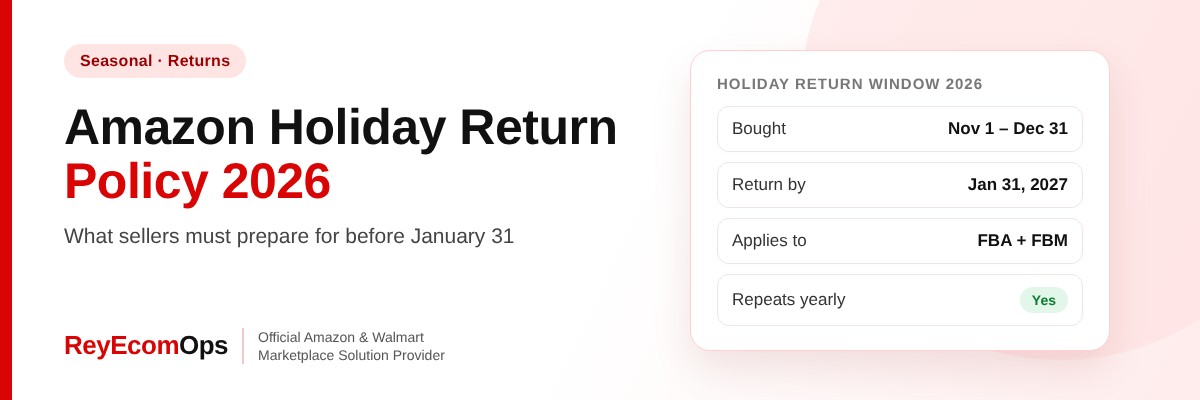
Every holiday season, shoppers buy early because they know they can return late. The Amazon holiday return policy for 2026 gives buyers until the end of January to send back most gifts, and it applies to your orders whether you use FBA or ship them yourself. That means the money you make in November and December isn’t fully yours until February.
This guide explains exactly what the 2026 policy says, how it affects FBA and merchant-fulfilled sellers differently, and the steps that protect your cash flow, stock and reimbursements through January.
Quick answer: Most items bought on Amazon from November 1 to December 31, 2026 can be returned until January 31, 2027, and Amazon says the window now repeats every year. It applies to FBA and seller-fulfilled orders, so plan Q1 cash flow, restocking and reimbursement checks around late returns.
In this guide
- Amazon’s Holiday Return Policy for 2026
- FBA vs Seller-Fulfilled: Who Handles What
- How Late Returns Hit Your Q1 Cash Flow
- Where Holiday Returns Leak Money
- Your Holiday Returns Timeline
- Unsellable Returns: What to Do With Them
- How to Reduce Holiday Returns
- Protect Your Account Health in January
- Holiday Return Policy vs Standard Returns
- Example: A Toy Seller’s January
- Seller Checklist Before January 31
- FAQs
1. Amazon's Holiday Return Policy for 2026
Amazon’s standard return window for most items is 30 days. During the holidays it is extended so gifts can be returned after they are opened. For 2026, the details are:
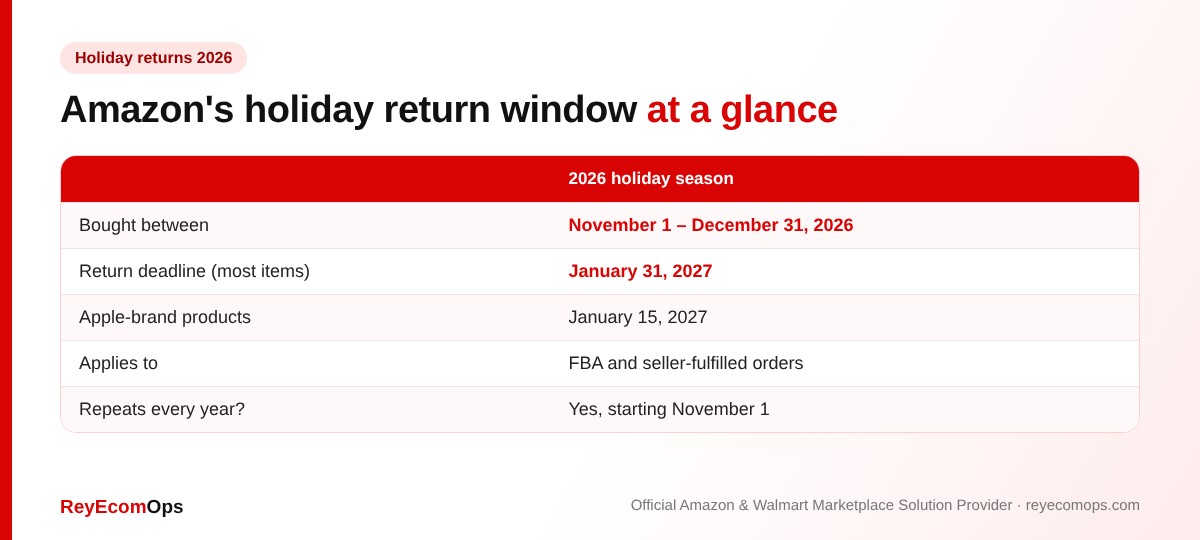
The holiday window extends the deadline. It does not change which items are returnable or the refund rules for each category. Items that were non-returnable before, such as some personal care or digital products, stay non-returnable.
2. FBA vs Seller-Fulfilled: Who Handles What
| FBA sellers | Seller-fulfilled (FBM) | |
|---|---|---|
| Who receives the return | Amazon | You |
| Who inspects the unit | Amazon decides sellable or unsellable | You do |
| Holiday window applies? | Yes | Yes |
| Main risk | Missing or damaged units, wrong stock status | Slow responses and A-to-z claims |
| Response time | Handled by Amazon | Answer requests within 24 hours |
A. FBA sellers
Amazon receives the return, inspects it and either adds it back to sellable stock or marks it unsellable. Refunds and any return processing fees for your category come out of your disbursements. Your job is to audit what comes back.
B. Seller-fulfilled sellers
You must accept returns that fall inside the holiday window and respond to every return request on time, including over holidays. Slow responses can turn into A-to-z Guarantee claims, which count toward your Order Defect Rate. Our account health monitoring watches for these in January.
3. How Late Returns Hit Your Q1 Cash Flow
January is when holiday refunds land. A seller with a strong December can see a large refund total in January, at the same time as storage fees for stock left over from Q4 and the bills for spring inventory. Plan for it:
- Estimate your return rate by category from last year and hold that share of December revenue in reserve.
- Delay big January purchase orders until you know how many units come back sellable.
- Track refunds weekly so a spike from one product gets noticed quickly.
- Remember that Amazon’s holiday peak fulfillment fees also apply until January 14, 2027.
Pro tip: use the free Amazon margin calculator to see what each return really costs once fees, shipping and lost resale value are included.
4. Where Holiday Returns Leak Money
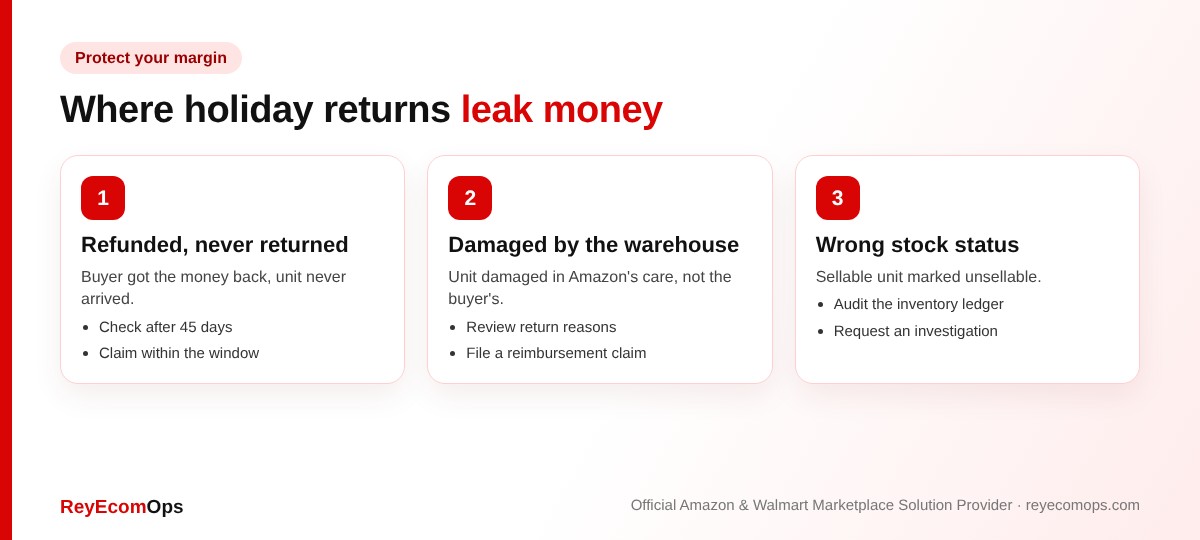
These problems are common after a big season and each one can qualify for a reimbursement if you file within the claim window, which is 60 days for most cases. Check the returns report and inventory ledger together, not separately.
Our FBA reconciliation service audits holiday returns every week so no claim expires before you file it.
Don’t let January refunds go unchecked
We’ll audit your returns and reimbursements for missing money.
5. Your Holiday Returns Timeline
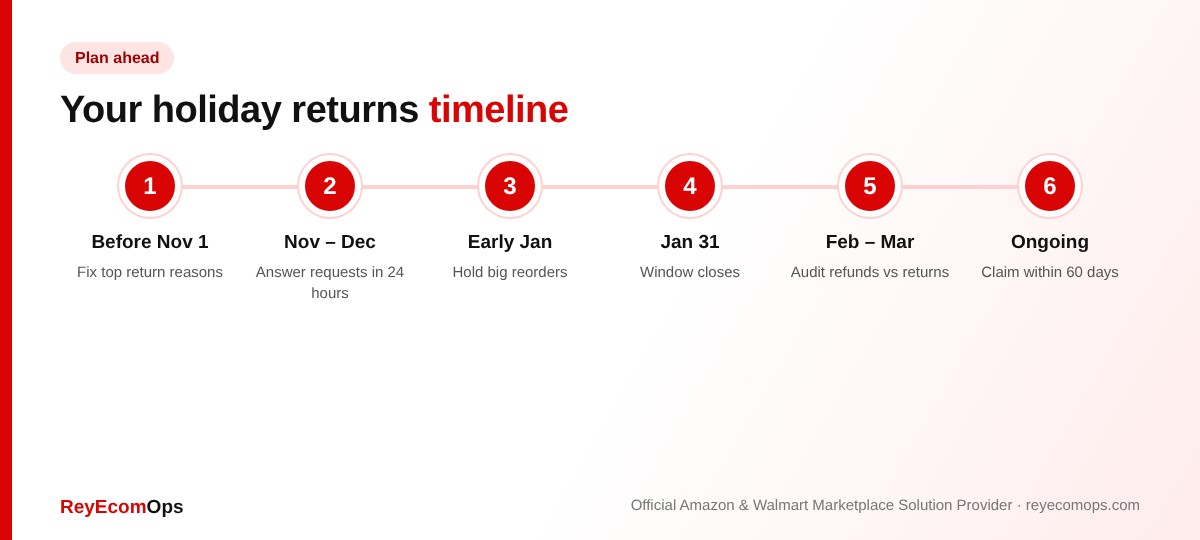
Treat returns as a season of their own. The work starts before November, peaks in January and finishes with an audit in February and March.
6. Unsellable Returns: What to Do With Them
FBA returns marked unsellable still cost you storage until you act. Review them in your inventory reports and choose one of three options: remove them back to your own warehouse, liquidate them where eligible, or dispose of them. If you believe a unit was damaged in Amazon’s warehouse rather than by the buyer, check whether it qualifies for reimbursement before you remove it.
7. How to Reduce Holiday Returns
A. Make the listing match reality
Clear size charts, exact dimensions, what’s in the box and compatibility details cut “not as described” returns. Our Amazon product listing services team rewrites listings to answer buyer questions before they become returns.
B. Show it properly
Images that show scale, true colors and every included part set the right expectations. A+ Content can answer the most common questions visually.
C. Protect the packaging
Damaged-in-transit returns are avoidable with better inner packaging, especially for glass, electronics and heavy items.
D. Read the return reasons
The returns report lists the buyer’s reason for every return. Fix the top reason for each product before the next season.
8. Protect Your Account Health in January
For merchant-fulfilled sellers, return requests and buyer messages must be answered within 24 hours, including holidays. Missed responses and A-to-z claims can push your metrics into the danger zone just as the season ends. If your account does get flagged, our Amazon Plan of Action guide shows how to respond.
9. Holiday Return Policy vs Standard Returns
The Amazon holiday return policy changes one thing, the deadline. Here is how it compares with the normal rules sellers work with for the rest of the year:
| Standard returns | Amazon holiday return policy | |
|---|---|---|
| Return window | 30 days from delivery (most items) | Until January 31, 2027 for Nov 1 – Dec 31 purchases |
| Eligible items | Category rules apply | Same category rules |
| Who refunds | Amazon (FBA) or you (FBM, via Amazon’s process) | Same |
| Reimbursement claim window | 60 days for most cases | Same, so January claims expire in March |
| Peak volume | Spread through the year | Concentrated in late December and January |
Because returns pile up in January, the 60-day reimbursement window for many of them ends in March. Sellers who wait until spring to reconcile often find the claim window already closed.
10. Example: A Toy Seller's January
Picture a toy brand that sells 4,000 units in December, mostly through FBA. With a typical return rate for gifts, a few hundred units come back between December 26 and January 31. A weekly audit of the returns report and inventory ledger might find that:
- Most returned units are restocked as sellable, as expected.
- A small group were refunded but never scanned back into a warehouse after 45 days.
- A handful were marked as customer-damaged although the return reason was “arrived late”.
- Several units were marked unsellable even though the packaging was intact.
Each of those last three groups can be raised with Amazon. Filed in February, the claims land inside the window. Left until April, many would be too late. That is why the holiday return policy matters for your margin long after the last gift has shipped.
11. Seller Checklist Before January 31
- Read Amazon’s holiday return policy notice in Seller Central for any category changes.
- Set FBM return settings so eligible holiday returns are authorized automatically.
- Plan who answers buyer messages over Christmas and New Year.
- Reserve cash for January refunds and hold back big reorders.
- Download the returns report and inventory ledger every week from late December.
- File reimbursement claims as soon as a unit is overdue or wrongly marked.
- Fix the top return reason for each product before next season.
If late shipments also crept up during the rush, our late shipment Plan of Action example shows how to bring the rate back under 4%.
Key takeaways
- Holiday purchases from Nov 1 to Dec 31, 2026 can be returned until Jan 31, 2027.
- The policy covers both FBA and seller-fulfilled orders.
- Hold part of December revenue for January refunds.
- Audit returns for missing or warehouse-damaged units and claim within 60 days.
- Better listings, images and packaging reduce returns.