Amazon Seller Account Deactivated? Why It Happens and How to Get It Back (2026)
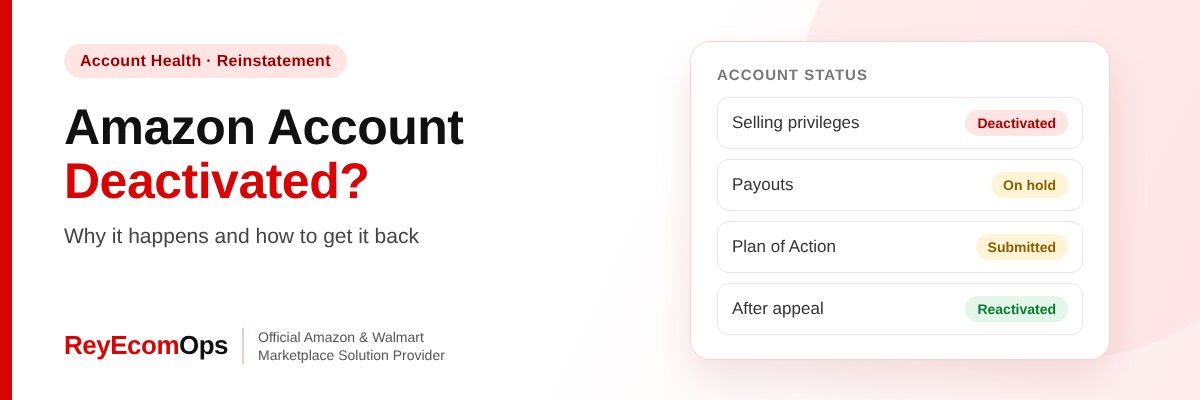
Few emails scare a seller more than “Your Amazon selling account has been deactivated.” Sales stop, listings go inactive and payouts can be held. If your Amazon seller account is deactivated, the good news is that most cases can be reversed when you respond quickly and correctly.
This guide explains the difference between the statuses Amazon uses, the most common reasons for deactivation, what happens to your money and FBA stock, and the exact steps to get reactivated.
Quick answer: Amazon deactivates a seller account when it fails a performance target, a verification check or a policy review. Selling stops and payouts can be held. To reactivate, read the exact reason in Account Health, fix it, and submit one complete appeal with a Plan of Action and supporting documents.
In this guide
- Deactivated, Suspended, On Hold or Under Review?
- Why an Amazon Seller Account Gets Deactivated
- What Happens to Your Funds and FBA Inventory
- How to Reactivate Your Account, Step by Step
- How Long Does Reactivation Take?
- Account Deactivated vs Listing Deactivated
- Deactivated During Q4: What to Do First
- How to Prevent Deactivation
- What to Send Amazon When Your Account Is Deactivated
- Common Mistakes That Keep Accounts Deactivated
- FAQs
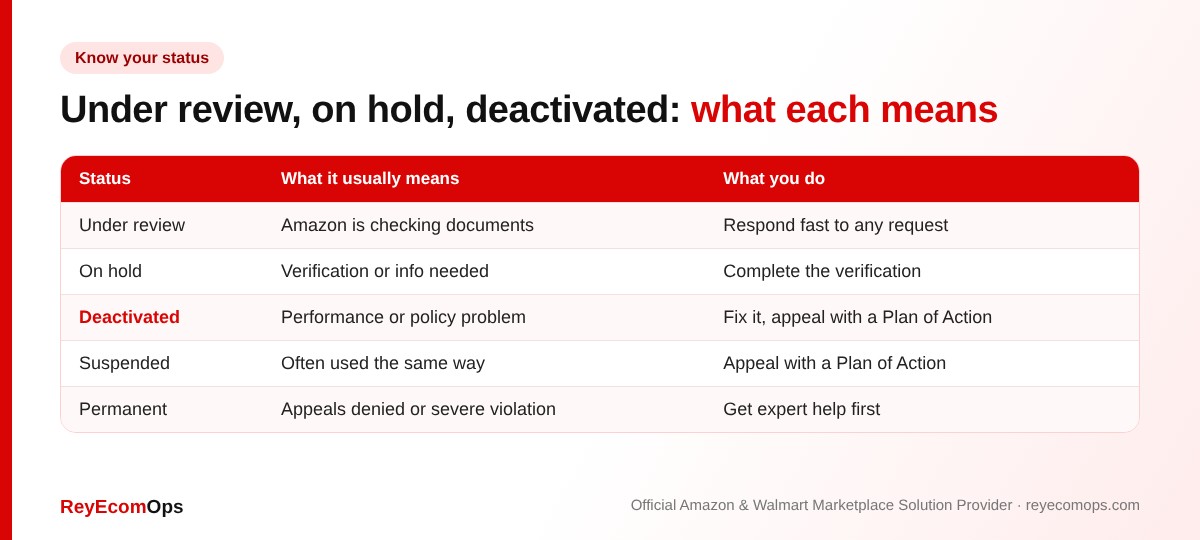
1. Deactivated, Suspended, On Hold or Under Review?
Amazon uses several terms that sound similar but need different responses. Getting this right saves days, because an Amazon seller account deactivated for performance needs a different fix from one on hold for verification.
2. Why an Amazon Seller Account Gets Deactivated
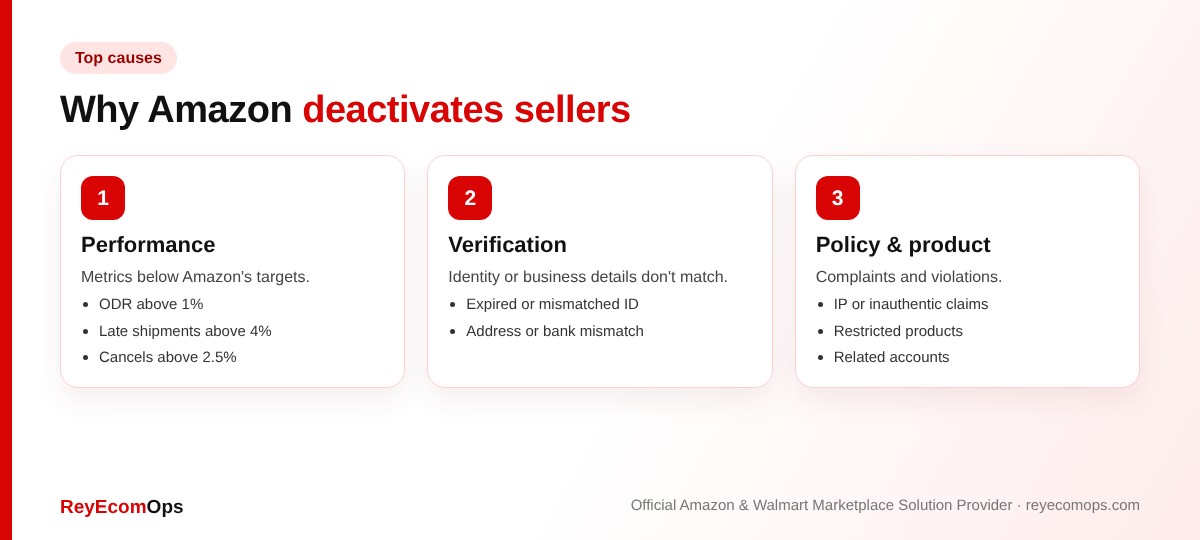
A. Performance metrics
An Order Defect Rate above 1%, a Late Shipment Rate above 4% or a pre-fulfillment cancel rate above 2.5% can trigger deactivation. These usually build up over weeks, so most performance cases of an Amazon seller account deactivated are preventable. Our late shipment Plan of Action example shows how to recover from the most common one.
B. Seller verification
Amazon may ask you to re-verify your identity, business address or bank details at any time. Mismatched names, expired IDs or a utility bill that doesn’t match your registered address are the most common problems.
C. Policy and product complaints
Intellectual property complaints, inauthentic item claims, restricted products and listing policy violations lower your Account Health Rating. If the rating stays in the at-risk zone, deactivation follows.
D. Related accounts
If Amazon links your account to another account that was suspended, through shared bank accounts, addresses, devices or people, your account can be deactivated too.
3. What Happens to Your Funds and FBA Inventory
| Area | What happens while deactivated |
|---|---|
| Funds | Disbursements may be held until the issue is resolved |
| FBA inventory | Stays in Amazon’s warehouses but can’t be sold; storage fees still apply |
| Listings | Become inactive; ranking can slip the longer you’re offline |
| Open FBM orders | Should still be shipped to protect your record |
| Ads | Stop serving on inactive listings |
Warning: never open a new account to get around a deactivation. It breaks Amazon’s policies and can lead to both accounts being permanently closed.
4. How to Reactivate Your Account, Step by Step
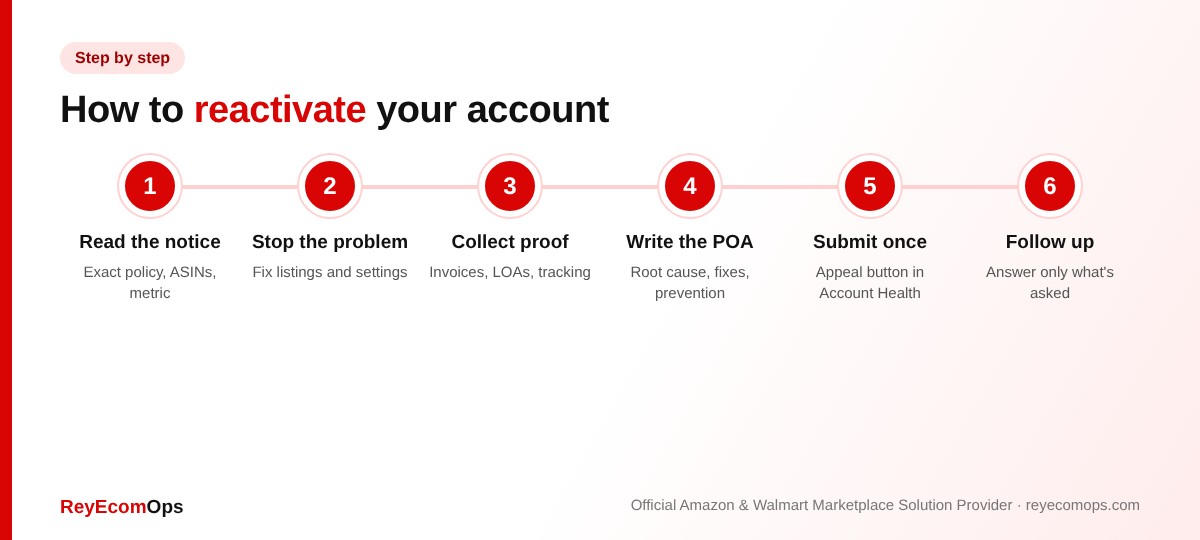
- Read the notice and Account Health. Find the exact policy, ASINs or metric named. Don’t guess.
- Stop the problem. Remove or fix listings, pause a problem supplier, update verification documents.
- Collect proof. Invoices, letters of authorization, tracking data or corrected screenshots.
- Write a Plan of Action. Root cause, corrective actions and preventive measures. Our Amazon Plan of Action template walks you through it.
- Submit once, completely. Use the Appeal button on the Account Health page.
- Answer follow-ups precisely. Respond only to what Amazon asks.
Deactivated right now?
Send us your notice. We’ll review it and your documents for free.
5. How Long Does Reactivation Take?
Simple verification or metric issues can be resolved in a few days once you send the right information. Complex cases, such as inauthentic claims or related accounts, can take weeks and may need more than one round of documents. The biggest delays come from incomplete first appeals.
6. Account Deactivated vs Listing Deactivated
Not every warning means your whole account is down. Amazon can deactivate a single listing for a product policy issue, a safety complaint or missing compliance documents while the rest of the account keeps selling. A single listing needs a targeted fix and, if asked, a short appeal for that ASIN. A full account deactivation needs the complete Plan of Action process above.
7. Deactivated During Q4: What to Do First
Having your Amazon seller account deactivated in November or December hurts more because every day offline is a peak sales day. Move fast, but don’t rush the appeal. A complete first appeal is quicker than three incomplete ones.
- Keep shipping open seller-fulfilled orders and answering buyers.
- Pause ads so you aren’t paying for clicks on listings that can’t sell.
- Move ad budget to other channels such as Walmart or your own website for now.
- Collect every document before writing a single sentence of the Plan of Action.
8. How to Prevent Deactivation
- Check Account Health and your Account Health Rating every week.
- Answer every policy warning before it escalates.
- Keep supplier invoices and authorization letters organized by ASIN.
- Keep business, bank and address details consistent everywhere.
- Watch Order Defect Rate, Late Shipment Rate and cancellations daily in Q4.
Our Amazon account health monitoring service runs these checks for you, and our Amazon account management team, an Official Amazon Marketplace Solution Provider, can run the whole account day to day.
9. What to Send Amazon When Your Account Is Deactivated
Every appeal is different, but the strongest ones share the same parts. Match each part to the reason in your notice:
| Reason for deactivation | Key documents | What the Plan of Action must prove |
|---|---|---|
| Performance metrics | Order data, carrier tracking, new process notes | You found why orders went wrong and changed the process |
| Seller verification | Matching ID, bank statement, utility bill | Your details are genuine and consistent |
| Inauthentic or IP complaint | Supplier invoices, letters of authorization | Your stock is genuine and you have the right to sell it |
| Restricted product | Removed listing, compliance documents | You no longer list it or now meet the rules |
| Related account | Explanation of the link, proof of separation | The link is not a policy breach or has been ended |
“Our account was deactivated because our Order Defect Rate rose to 1.6% between October 1 and November 10. We reviewed every defective order and found three root causes: a carrier pickup failure, an out-of-date handling time on 12 ASINs and slow replies to buyer messages over a weekend…”
Notice that it names the metric, the dates and the causes in the first two sentences. Amazon reviewers read many appeals a day, so specific facts up front get your appeal understood faster.
10. Common Mistakes That Keep Accounts Deactivated
- Blaming Amazon, buyers or carriers. Take responsibility for what you control.
- Sending vague promises. “We will be more careful” is not a preventive measure. Name the new check, who owns it and how often it runs.
- Submitting many appeals in a row. Each weak appeal makes the next review harder.
- Sending edited or mismatched documents. Invoices must match the brand, quantities and your business name.
- Ignoring follow-up questions. Answer exactly what is asked, quickly.
If you find your Amazon seller account deactivated and you are not sure which reason applies, our account health specialists can read the notice and documents with you before you send anything.
Key takeaways
- Deactivation stops selling and can hold your payouts.
- Read the exact reason in Account Health before you act.
- Fix the cause, gather proof and appeal once with a Plan of Action.
- Never open a second account to get around a deactivation.
- Weekly Account Health checks catch problems early.