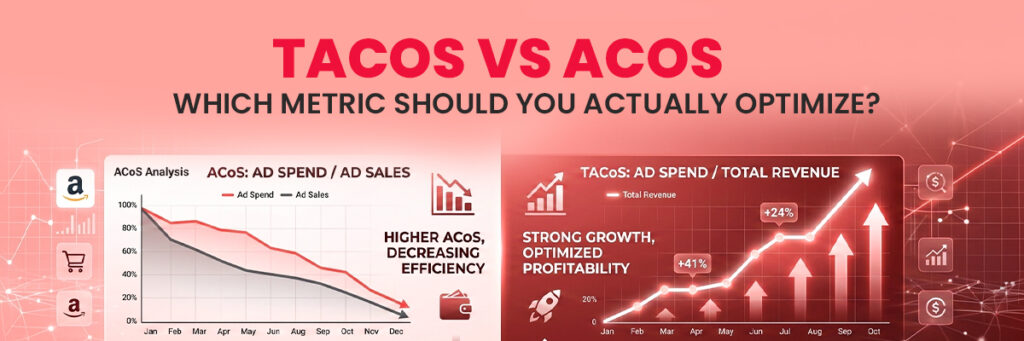
When running marketplace ads, most sellers obsess over one metric — ACoS. While ACoS is important, focusing only on it can limit long-term growth. Smart advertisers and professional ecommerce account management services focus on a broader profitability signal: TACoS.
Understanding how these two metrics work together is essential for sustainable scaling on marketplaces like Amazon, Walmart, and other e-commerce platforms.
What is ACoS?
ACoS (Advertising Cost of Sale) measures how much ad spend is required to generate advertising revenue.
Formula:
ACoS = (Ad Spend ÷ Ad Revenue) × 100
Example
If you spend $200 on ads and generate $1,000 in ad sales, your ACoS is:
ACoS = 20%
Why Sellers Track ACoS
ACoS helps advertisers measure campaign efficiency. A lower ACoS means your ads are generating sales more efficiently.
However, ACoS only looks at sales generated directly from ads, which means it does not reflect the total business impact of advertising.
What is TACoS?
TACoS (Total Advertising Cost of Sale) measures advertising spend against total revenue, including both ad-driven and organic sales.
Formula:
TACoS = (Ad Spend ÷ Total Revenue) × 100
Example
If you spend $200 on ads and your total sales are $2,000, your TACoS is:
TACoS = 10%
This metric gives a more accurate picture of how advertising contributes to overall store performance.
The Core Difference Between TACoS and ACoS
| Metric | What It Measures | Why It Matters |
|---|---|---|
| ACoS | Ad spend vs ad-generated sales | Measures campaign efficiency |
| TACoS | Ad spend vs total sales | Measures business growth impact |
Many sellers only track ACoS, but experienced ecommerce account services providers focus on TACoS because it reflects how ads support organic growth.
Why Optimizing Only ACoS Can Hurt Growth
When advertisers try to aggressively lower ACoS, they often:
Reduce bids
Pause high-traffic keywords
Limit campaign reach
While this may improve ACoS in the short term, it can reduce sales velocity and keyword ranking, ultimately hurting organic visibility.
Marketplace algorithms reward performance signals such as CTR, conversions, and sales velocity, which often require sustained ad investment.
Why TACoS Is a Better Long-Term Metric
TACoS helps businesses understand whether advertising is fueling organic growth.
If your advertising strategy is working properly, you will typically see:
ACoS stable or slightly high
TACoS gradually decreasing
Organic sales increasing
This indicates that advertising is helping products rank higher and generate more non-ad sales.
Professional marketplace account services teams often monitor TACoS trends to evaluate long-term performance rather than focusing only on short-term ad efficiency.
When Should You Focus on ACoS?
ACoS is most useful when optimizing individual campaigns and keywords.
You should monitor ACoS when:
Controlling campaign profitability
Testing new keywords
Optimizing bids and budgets
Improving campaign efficiency
ACoS helps ensure that campaigns are not overspending relative to direct ad revenue.
When Should You Focus on TACoS?
TACoS should be monitored at the business level, not just the campaign level.
This metric is critical when evaluating:
Overall store profitability
Organic growth impact of ads
Product launch strategies
Long-term scaling
Many e-commerce account management services use TACoS as a key KPI when scaling marketplace brands.
The Ideal Scenario: Optimizing Both
The most effective marketplace strategy balances both metrics.
A healthy account usually shows:
Stable ACoS
Declining TACoS
Increasing organic sales share
This indicates that ads are successfully driving visibility while organic ranking continues to grow.
Final Thoughts
ACoS tells you whether your ads are efficient, but TACoS tells you whether your business is growing.
For sustainable marketplace success, advertisers must go beyond campaign-level metrics and analyze the bigger picture. Professional e-commerce account management services combine ACoS optimization with TACoS monitoring to ensure both profitability and long-term growth.
When used together, these metrics provide the clarity needed to build a scalable and profitable marketplace advertising strategy.