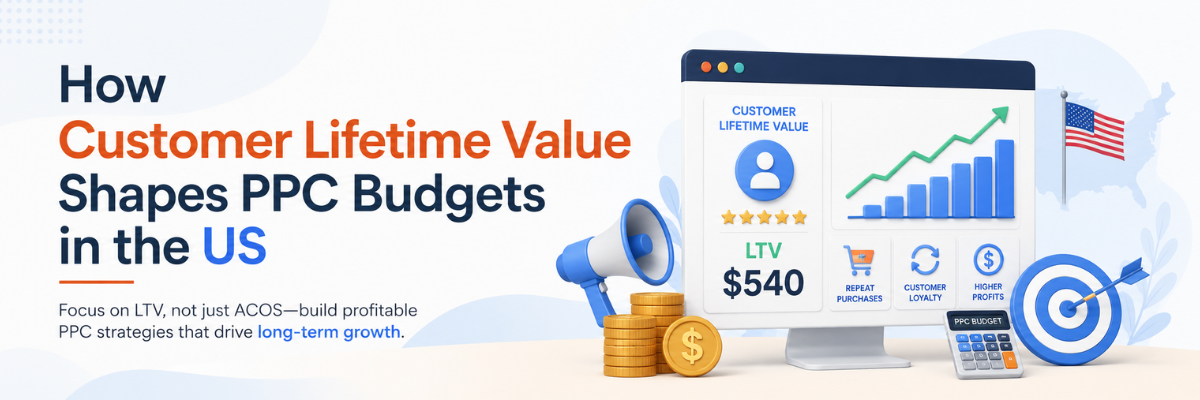
Many Amazon sellers in the United States still measure advertising success using only Advertising Cost of Sales (ACoS). While ACoS is an important metric, relying on it alone can prevent businesses from scaling profitably.
Successful brands understand that the real objective isn’t simply lowering advertising costs—it’s maximizing the value each customer generates over time. This is where Customer Lifetime Value (LTV) becomes a game-changing metric.
When businesses build PPC strategies around Amazon LTV USA, they make smarter budget decisions, acquire higher-quality customers, and generate stronger long-term profitability instead of chasing short-term efficiency.
In this guide, we’ll explore why Customer Lifetime Value should influence every PPC budget and how businesses can use it to build sustainable growth.
What Is Customer Lifetime Value (LTV)?
Customer Lifetime Value (LTV) is the total revenue or profit a customer is expected to generate throughout their relationship with your brand.
Instead of evaluating only the first purchase, LTV measures the long-term value of customer retention.
Basic Formula
Customer Lifetime Value = Average Order Value × Purchase Frequency × Customer Lifespan
For example:
- Average Order Value: $45
- Purchases Per Year: 4
- Average Customer Lifespan: 3 Years
LTV = $45 × 4 × 3 = $540
A customer worth $540 over three years justifies a much higher acquisition cost than someone who purchases only once.
Why Many US Amazon Sellers Focus Too Much on ACoS
Advertising Cost of Sales (ACoS) measures:
Ad Spend ÷ Ad Revenue × 100
Many businesses try to achieve the lowest possible ACoS because it appears more profitable.
However, this approach often creates hidden problems:
- Reducing bids too aggressively
- Losing keyword visibility
- Missing new customer acquisition
- Slower sales growth
- Lower brand awareness
- Limited long-term expansion
A campaign with a 35% ACoS may actually outperform one with 18% ACoS if it consistently brings in loyal repeat customers.
Why LTV Matters More Than Initial Profit
Imagine two campaigns.
Campaign A
- ACoS: 18%
- Customers purchase only once.
- Lifetime Value: $40
Campaign B
- ACoS: 34%
- Customers purchase multiple times.
- Lifetime Value: $250
Campaign B may appear less efficient initially but produces significantly more profit over time.
This is why experienced ecommerce ad management teams prioritize customer value instead of focusing only on immediate advertising efficiency.
The Relationship Between Amazon PPC and Customer Lifetime Value
Amazon PPC is often viewed as a tool for generating immediate sales.
In reality, it serves a much larger purpose:
- Acquiring new customers
- Introducing shoppers to your brand
- Increasing repeat purchases
- Growing brand loyalty
- Expanding customer relationships
Each first purchase creates future revenue opportunities through:
- Repeat purchases
- Subscribe & Save programs
- Cross-selling
- Upselling
- Product launches
- Brand referrals
The first sale should be viewed as the beginning of customer value—not the end.
How LTV Helps Allocate PPC Budgets More Effectively
1. Invest More in High-Value Products
Not every product attracts the same type of customer.
Some products naturally lead to:
- Repeat orders
- Consumable purchases
- Subscription opportunities
- Product ecosystem expansion
These products deserve larger advertising budgets because they create greater lifetime revenue.
2. Spend More on New Customer Acquisition
Many sellers hesitate to bid aggressively for competitive keywords.
However, if new customers consistently generate repeat purchases, higher acquisition costs become worthwhile.
Example:
- Initial acquisition cost: $32
- First purchase profit: $5
- Repeat customer value: $180
The campaign becomes highly profitable over time.
3. Protect Your Best Customer Segments
Customer data often reveals that certain audiences deliver much higher LTV.
Examples include:
- Premium shoppers
- Brand followers
- Subscribe & Save customers
- Frequent buyers
- High-value geographic regions
Increasing PPC investment toward these audiences improves long-term ROI.
Using LTV to Set Better PPC Goals
Instead of asking:
“How can we reduce ACoS?”
Ask:
- Which campaigns generate repeat customers?
- Which keywords attract loyal buyers?
- Which products create long-term revenue?
- Which audiences deliver the highest LTV?
- Which campaigns grow customer relationships?
These questions produce more profitable advertising decisions.
Budget Allocation Based on Customer Value
An LTV-focused advertising strategy often distributes budgets differently.
Brand Defense Campaigns
- Protect loyal customers
- Maintain visibility
- Capture repeat buyers
Budget Priority: High
New Customer Campaigns
- Target broad keywords
- Reach first-time shoppers
- Increase brand awareness
Budget Priority: Very High
Competitor Campaigns
- Win customers from competing brands
- Expand market share
Budget Priority: Moderate
Retargeting Campaigns
- Recover interested shoppers
- Encourage repeat purchases
Budget Priority: High
Product Launch Campaigns
- Acquire early customers
- Build momentum
- Generate reviews
Budget Priority: High
Common Mistakes When Ignoring Customer Lifetime Value
Businesses often make costly decisions by focusing solely on immediate profitability.
These include:
Cutting Winning Campaigns Too Early
Some campaigns appear expensive during the first month but become extremely profitable over time.
Underinvesting in Customer Acquisition
If every campaign must achieve low ACoS immediately, brands often fail to acquire enough new customers for future growth.
Ignoring Repeat Purchase Behavior
Customers who buy repeatedly often justify significantly higher advertising costs.
Without measuring LTV, these opportunities remain hidden.
Evaluating Every Product the Same Way
Products with recurring demand deserve larger advertising investments than one-time purchases.
How Ecommerce Ad Management Improves LTV
Professional ecommerce ad management focuses on the entire customer journey rather than individual transactions.
Key activities include:
Customer Segmentation
Identify high-value customer groups.
Keyword Optimization
Target search terms that attract loyal buyers.
Campaign Scaling
Increase budgets for campaigns producing stronger lifetime returns.
Product-Level Analysis
Measure repeat purchase behavior across different products.
Audience Insights
Understand which demographics create the highest long-term profitability.
Best Practices for LTV-Based PPC Budget Planning
To maximize profitability:
- Measure customer lifetime value regularly.
- Track repeat purchase rates.
- Segment customers by purchase behavior.
- Increase budgets for high-LTV products.
- Focus on customer acquisition rather than only low ACoS.
- Use branded campaigns to encourage repeat purchases.
- Evaluate advertising over longer time periods.
- Monitor contribution margin instead of only advertising efficiency.
Why US Brands Are Shifting Toward LTV-Based Advertising
Competition across Amazon continues to increase every year.
Lowering bids alone is no longer enough to remain competitive.
Brands that consistently outperform competitors:
- Invest in customer acquisition
- Build long-term loyalty
- Expand customer relationships
- Increase repeat purchases
- Optimize total customer value
These businesses understand that sustainable growth comes from maximizing customer value—not minimizing advertising costs.
Conclusion
Advertising success isn’t determined by the lowest ACoS—it’s determined by the total profit customers generate throughout their relationship with your brand.
By focusing on Amazon LTV USA, businesses gain a more accurate understanding of advertising performance and make smarter decisions about PPC budget allocation.
When customer lifetime value guides your advertising strategy, higher acquisition costs often lead to greater profitability, stronger customer retention, and long-term business growth.
For businesses looking to scale consistently, combining LTV insights with expert ecommerce ad management creates a foundation for sustainable success across Amazon and other online marketplaces.e