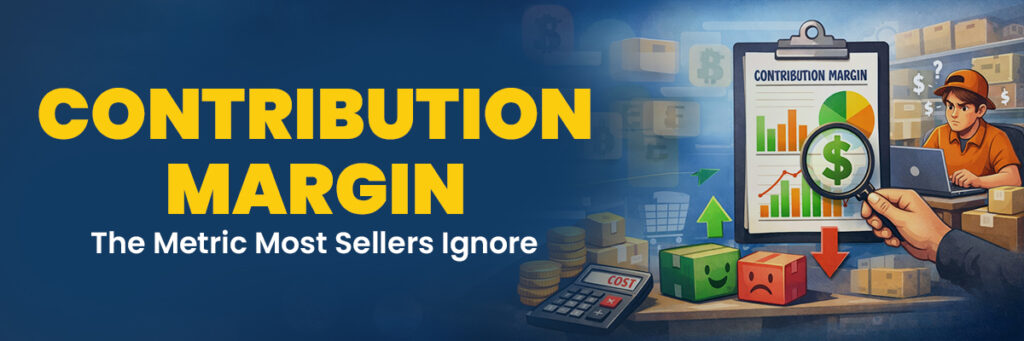
Most e-commerce sellers focus on revenue, orders, and ad performance—but very few truly understand their contribution margin. And that’s where the real problem begins.
You can generate high sales and still lose money. Without tracking contribution margin, you’re operating blindly, scaling numbers instead of profits.
What is Contribution Margin?
Contribution margin is the amount left after subtracting variable costs from your revenue.
It tells you how much money is actually contributing toward your profit after covering essential selling expenses.
Formula:
Contribution Margin = Revenue – Variable Costs
Variable costs typically include:
- Product cost
- Marketplace commissions
- Shipping & logistics
- Advertising (PPC spend)
- Payment processing
Why Most Sellers Ignore It
The reason is simple—vanity metrics look better.
Sellers often focus on:
- Revenue growth 📈
- High order volume
- Low ACoS (Advertising Cost of Sale)
But these numbers don’t tell the full story. A product with great sales and decent ACoS can still have poor contribution margin, especially when hidden costs stack up.
The Real Impact on Your Business
Ignoring contribution margin leads to:
1. False Profit Assumptions
You think you’re profitable—but in reality, you’re barely breaking even (or worse, losing money).
2. Scaling the Wrong Products
You push products with high sales but low margins, which drains your cash flow over time.
3. Poor Ad Decisions
Without margin clarity, you either overspend on ads or stop campaigns that are actually profitable.
How Ecommerce Account Management Fixes This
Professional ecommerce account management focuses on profitability—not just revenue.
Here’s how:
1. Margin-Based Product Selection
Instead of chasing trends, products are selected based on contribution margin potential.
2. Smart Pricing Strategy
Prices are optimized to maintain competitiveness while protecting margins.
3. Controlled Advertising Spend
Ad campaigns are structured around profitability (TACoS & margin), not just traffic.
4. Cost Optimization
From logistics to fees, every cost layer is analyzed and reduced where possible.
This is where ecommerce account management services and Marketplace account management services play a crucial role—bringing structure, visibility, and control to your business.
Simple Example (That Changes Everything)
Let’s say:
- Selling Price = $50
- Product Cost = $15
- Ads = $10
- Fees + Shipping = $12
Contribution Margin = $50 – ($15 + $10 + $12) = $13
That $13 is what actually contributes to your profit.
Now imagine scaling this product without knowing this number—you could easily overspend and wipe out your margins.
How to Start Tracking Contribution Margin
You don’t need complex tools to begin. Start with:
- A simple Excel sheet
- Product-wise cost breakdown
- Weekly tracking of ad spend and fees
Then gradually move to advanced dashboards as your business grows.
Final Thought
Revenue looks impressive. Profit builds businesses.
If you’re not tracking contribution margin, you’re not really scaling—you’re guessing.
Smart sellers don’t just chase sales—they understand what’s left after every sale. That’s where real growth begins.